Practitioner-only course · 2026

IFRS 17

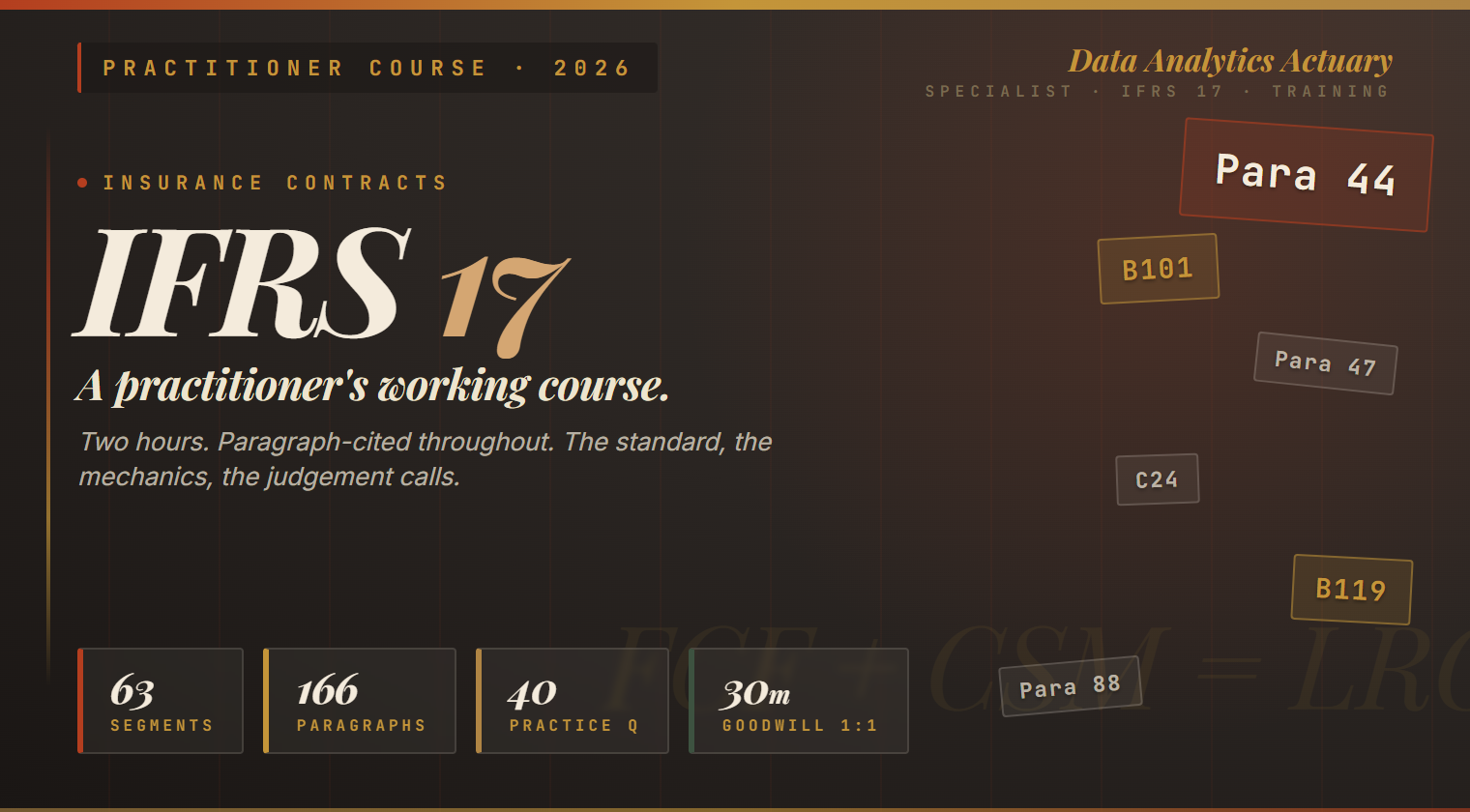
Two hours. Every concept anchored to its paragraph. The standard, the mechanics, the judgement calls.

A paragraph-cited working course for practising actuaries, accountants and auditors. Not an intro. Not a brochure. The version you actually use on Monday morning.

USD 102 · full course 1 year access 30 min goodwill 1:1 Paragraph-cited
IFRS 17, A Practitioner Course
63Video Segments
~2hrTotal Runtime
6Downloadable PDFs
30minGoodwill 1:1 Session
1yrFull Access

· The Promise ·

Most IFRS 17 courses are either a thirty-minute summary that leaves you no better off than reading a glossy consultancy brochure, or a thirty-hour deep-dive that nobody finishes. This is the version in between.

A two-hour, paragraph-cited practitioner course that takes you from scope and aggregation through transition, with every concept anchored to the standard itself. No folklore. No vendor interpretations. The paragraphs.

Four things other courses won't give you.

Built deliberately for the working practitioner, not the curious onlooker. Every choice in this course exists for a reason.

Paragraph-anchored

Not "the standard says…" but "Para 44 says…". You'll be able to cite paragraphs from memory by the end.

PDF resources to keep

Six beautifully designed PDFs (paragraph index, decision tree, CSM formula card, glossary, cheat sheet and flashcards) built to live on your second monitor long after the course is done. A ready reference, not just course material.

Honest about judgement

Fifty places in IFRS 17 need genuine judgement. The course names them and tells you how to defend yours.

Practitioner-grade

Built and taught by an IFRS 17 practitioner. Every concept tied to the audit conversation, the disclosure question, the election decision: the things you actually live with after the close.

Three things in the box.

Lean by design. Every component earns its place: videos to teach, PDFs to keep, and time with the instructor to make it stick.

I

Video segments

The complete IFRS 17 course on video: ten chapters, around seventy lessons, roughly two hours of dense, paragraph-cited teaching. You can finish it in a week and re-watch sections all year.

  • Section dividers + bridges, so context never drops
  • Every concept anchored to its IFRS 17 paragraph
  • Captions on every video
  • Watch on Thinkific web or mobile app
II

Downloadable PDFs

Reference resources designed to live on your second monitor while you work. Print, laminate, pin to the wall. They're yours to keep for the full year and beyond.

  • Paragraph index: concept → IFRS 17 paragraph
  • Measurement-approach decision tree (GMM · PAA · VFA)
  • CSM formula card: Day 1, roll-forward, coverage units
  • Glossary of every defined term in Appendix A
  • One-page cheat sheet: the whole standard at a glance
  • Section-by-section handwritten flashcards
III

30-minute goodwill 1:1 with the instructor

An extra thirty minutes of the instructor's time, offered as a goodwill discussion session. Not a consultancy engagement, not separately monetisable, not a guarantee. A fair add-on so you can sense-check your thinking with someone who works with the standard daily.

  • Goodwill discussion only, not paid consultancy
  • You schedule it and you set the scope
  • Sense-check your reading of a paragraph or measurement choice
  • Talk through an audit-committee question you're preparing for
  • To be booked within your year of access, subject to availability
  • Zoom or Teams, included in the course price

Six concrete outcomes.

If we do our job right, here's what you'll be able to do at the end. Read it as a contract: we deliver, you can do all of these.

Place any contract in or out of scope, citing the relevant paragraphs Para 3 · 7 · B12–B25

Choose between GMM, PAA and VFA with defensible reasoning, and document the eligibility test Para 53 · B101

Roll the CSM forward across a reporting period, line by line Para 44

Understand the impact of discount-rate shifts and the eight-line CSM roll-forward Para 36 · Para 44 · B72–B85

Defend the four big policy elections to an audit committee Para 88 · 89 · B115 · C20

Read IFRS 17 itself, paragraphs 1 to 132, and recognise every concept Para 1 → 132 + A · B · C

The CSM, alive on the page.

Even if you never buy the course, let me explain what the CSM is. Move the discount rate. Watch the building blocks shift, the CSM contract or expand, and the contract flip from profitable to onerous. This bit is on the house.

Inflows · Day 1
100PV Inflows (Premium)
=
Outflows expected · RA · CSM (the plug)
90.2PV Outflows
5RA
4.8CSM
Recognised in P&L · 0.0
Profitable CSM = 4.8 · No Day-1 P&L · Para 38
Discount rate 3.5%
Outflows nominal 100

The course includes CSM buildup and discount-rate impact demos.

Ten chapters. Seventy lessons.

Roughly two hours of teaching plus the PDFs to keep. Sections build on each other, but every lesson is also accessible standalone. Click any section below to see every lesson inside.

Chapter 01
Course overview
4 lessons · all Free preview
+
  1. 1.1 Free
    IFRS 17 · A Practitioner Introduction
  2. 1.2 Free
    Course at a Glance
  3. 1.3 Free
    Course Roadmap
  4. 1.4 Survey
    Pre-course Survey
Chapter 02
Foundations
4 lessons
+
  1. 2.1 Lecture
    Foundations · section intro
  2. 2.2 Lecture
    Two minutes on why this standard exists
  3. 2.3 Lecture
    Why IFRS 17 changes everything
  4. 2.4 Lecture
    The Standard's structure
Chapter 03
Scope, aggregation, recognition
13 lessons · quiz + 5 discussions
+
  1. 3.1 Lecture
    Overview
  2. 3.2 Lecture
    Three categories in, six exclusions out
  3. 3.3 Lecture
    What's within scope
  4. 3.4 Lecture
    What stays under other standards
  5. 3.5 Lecture
    Portfolio → Group → Cohort
  6. 3.6 Lecture
    The 'earliest of three' rule
  7. 3.7 Lecture
    Scope, aggregation, recognition · recap
  8. 3.8 Quiz
    Quiz 1
  9. 3.9 Discuss
    Question 1 · Discussion
  10. 3.10 Discuss
    Question 2 · Discussion
  11. 3.11 Discuss
    Question 3 · Discussion
  12. 3.12 Discuss
    Question 4 · Discussion
  13. 3.13 Discuss
    Question 5 · Discussion
Chapter 04
Building-block measurement
9 lessons
+
  1. 4.1 Lecture
    Overview
  2. 4.2 Lecture
    The dense section
  3. 4.3 Lecture
    The building-block formula
  4. 4.4 Lecture
    Three components in sequence · PVCF, RA, CSM
  5. 4.5 Lecture
    Present value of future cash flows
  6. 4.6 Lecture
    Risk Adjustment for non-financial risk
  7. 4.7 Lecture
    Discount rates
  8. 4.8 Lecture
    Yield-curve impact on FCF and CSM
  9. 4.9 Lecture
    CSM and Day-1 measurement
Chapter 05
Three measurement approaches · GMM · PAA · VFA
11 lessons · quiz + 5 answer reviews
+
  1. 5.1 Lecture
    Overview
  2. 5.2 Lecture
    Three acronyms
  3. 5.3 Lecture
    GMM · PAA · VFA
  4. 5.4 Lecture
    VFA · all three conditions
  5. 5.5 Lecture
    Measurement and the three approaches
  6. 5.6 Quiz
    Quiz 2
  7. 5.7 Lecture
    Quiz 2 · Question 1 review
  8. 5.8 Lecture
    Quiz 2 · Question 2 review
  9. 5.9 Lecture
    Quiz 2 · Question 3 review
  10. 5.10 Lecture
    Quiz 2 · Question 4 review
  11. 5.11 Lecture
    Quiz 2 · Question 5 review
Chapter 06
Subsequent measurement
6 lessons
+
  1. 6.1 Lecture
    Overview
  2. 6.2 Lecture
    Where the standard meets the spreadsheet
  3. 6.3 Lecture
    The CSM roll-forward · Para 44
  4. 6.4 Lecture
    The CSM waterfall
  5. 6.5 Lecture
    LRC and LIC · Para 40
  6. 6.6 Lecture
    Onerous mechanics · Para 47–52
Chapter 07
Presentation and disclosure
5 lessons
+
  1. 7.1 Lecture
    Overview
  2. 7.2 Lecture
    The income statement you knew is GONE!
  3. 7.3 Lecture
    The IFRS 17 income statement
  4. 7.4 Lecture
    The OCI election · Para 88–89
  5. 7.5 Lecture
    Risk taxonomy
Chapter 08
Transition and elections
7 lessons · two quizzes
+
  1. 8.1 Lecture
    Overview
  2. 8.2 Lecture
    Transition is done · but the decision lives FOREVER
  3. 8.3 Lecture
    Three transition approaches
  4. 8.4 Lecture
    The eight policy elections
  5. 8.5 Lecture
    Presentation, transition, elections · recap
  6. 8.6 Quiz
    Quiz 3 · Transition and elections
  7. 8.7 Quiz
    Quiz 3
Chapter 09
Lifecycle and wrap-up
6 lessons · final test
+
  1. 9.1 Lecture
    Overview
  2. 9.2 Lecture
    The full IFRS 17 lifecycle
  3. 9.3 Lecture
    Ten things to remember
  4. 9.4 Discuss
    Standing back · the standard as a whole
  5. 9.5 Final test
    25 questions to lock it in · practitioner-level
  6. 9.6 Lecture
    Thank you · and what's next
Chapter 10
Resources · yours to keep
5 PDFs
+
  1. 10.1 PDF
    Resource 1 · Paragraph index
  2. 10.2 PDF
    Resource 2 · Decision tree
  3. 10.3 PDF
    Resource 3 · CSM formula
  4. 10.4 PDF
    Resource 4 · Glossary
  5. 10.5 PDF
    Resource 5 · Cheat sheet

Pulled directly from the live Thinkific table of contents. Chapter 01 is fully free-preview · no purchase needed to sample.

Built by a practitioner, for practitioners.

Jabran Noor
Specialist IFRS 17 Consultant & Trainer

I've been working on IFRS 17 since the early exposure draft: preparing the numbers, reviewing them, modelling them, auditing them, developing the calculation engines that produce them, and training the teams who do all of the above. Across life, P&C and reinsurance books, with experience spanning EMEA and Australia.

I built this course because every IFRS 17 programme I'd taught from felt either too thin to be useful or too long to be finished. The version in between is the one practitioners actually want.

Every paragraph reference in this course traces back to the standard. Every worked example came from a real engagement.

jabran@ifrs-17.com · Data Analytics Actuary

"There's a remarkable amount of folklore around IFRS 17 that doesn't actually appear in the standard. When somebody on a project tells you 'the standard says…', politely ask which paragraph. If they can't answer, the claim is suspect."

From Section 08, Lecture 24

Consultancy enquiries

Separate from this course

Alongside the course I run an active IFRS 17 consultancy practice: technical advisory, audit and actuarial expert work, calculation-engine design and end-to-end implementation support. If you have a defined piece of work in mind, those are paid engagements, separate from the course.

Drop a line to jabran@ifrs-17.com with a brief scope. Happy to scope, quote, or refer onward where someone else is the better fit.

Who this course is for, and who it isn't.

Honesty is faster than fluff. Read this before you enroll. We'd rather you self-select out than join and not get value.

ForPractitioners

  • Practising actuaries: life, health, P&C, reinsurance
  • Financial-reporting accountants and controllers at insurers
  • Audit professionals reviewing IFRS 17 numbers
  • Risk, capital, and actuarial-function staff
  • Consultants on IFRS 17 implementation or model build
  • L&D leads at insurers or audit firms
  • Staff at regulatory bodies wanting a paragraph-anchored working understanding of IFRS 17

NotThis isn't for you if

  • You want free consultancy. The 30-minute 1:1 is a goodwill discussion, not paid advisory work.
  • You're new to insurance accounting and want a beginner-friendly intro
  • You want an exam-prep cram for a specific qualification
  • You want a generic compliance video for HR to tick a box
  • You expect a thirty-minute summary to replace real study
  • You don't yet know what a present value is
  • You are medically allergic to acronyms. IFRS 17 is an acronym paradise: GMM, PAA, VFA, CSM, FCF, PVCF, RA, LRC, LIC, DPF, OCI, IFE, IBNR, FRA, MRA, FVA, RVG…
  • You're one of the people who drafted the Standard. In which case, please send the invitation the other way around, we'd like to enroll on your course.

One price. Everything included.

No upsells, no add-ons. The whole course, the resources to keep, and time with the instructor, all for a single flat fee.

Full practitioner course
USD 102
One-time payment · no subscription
~70 lessons across 10 chapters: ~2 hours of teaching, plus quizzes & discussion threads
Six downloadable PDFs: yours to keep, refreshed during the year
30-minute goodwill 1:1 with the instructor (discussion session, not consultancy)
One year of access: every segment, every update
Pitched at working practitioners. Bring some IFRS 17 context.
Enroll on Thinkific →
Secure checkout via Thinkific · questions? jabran@ifrs-17.com

What people ask on DM.

If your question isn't here, email jabran@ifrs-17.com and you'll get an answer within a working day.

Is this an introduction to IFRS 17?
No. It's a practitioner course. It assumes you already know what a present value and an insurance liability are. If you're starting from scratch, you'll want a more foundational programme first. We can suggest one.
How long does it take to finish?
The video material is roughly two hours of teaching, so technically you can get through it once in a single afternoon. Please don't. The course is broken into around six distinct topic groupings (scope and aggregation, building-block measurement, the three approaches, onerous mechanics, presentation and disclosure, transition and elections), and each grouping is its own self-contained, fairly dense piece of teaching. You wouldn't watch a soap opera back-to-back with a horror movie. Same idea here. Take your time, pause between groupings, let one settle before you start the next.

Over your year of access I expect you to revisit sections four or five times as the work in front of you changes: reporting close, an onerous test landing on a portfolio, transition discussions with audit. The PDFs are there for the moments in between.

Most importantly, act like a practitioner rather than a student. Read the standard alongside the videos. Take notes. Print the PDFs and highlight them. Engage in discussions with colleagues. Revisit decisions you've already made on your book and ask whether the standard agrees. Write policy papers when something doesn't sit right. The course is a structured way in; the work afterwards is what makes you fluent.

The course also includes open-ended discussion prompts woven through each major section. No model answers, no neat resolutions, just questions to sit with. Imagine yourself in an audit-committee meeting, making a real decision with less-than-perfect information. That is the posture the course is preparing you for. Treat the prompts as rehearsals: form a view, defend it, write it down, then check it against how your own organisation actually decided.
Why USD 102?
A nod to paragraphs 1–132 of IFRS 17. One flat price for the whole course, one year of access, and a 30-minute goodwill discussion session with the instructor. No upsells, no hidden tiers.
What's the 30-minute goodwill 1:1?
Thirty minutes of the instructor's time, offered as a goodwill discussion session. It is not a consultancy engagement, it is not a guarantee, and it is not separately monetisable. It is a fair add-on to the course price so that you can sense-check your thinking with someone who works with the standard daily.

A few ground rules so we stay fair to each other:
  • It is the student's responsibility to schedule the session and agree the scope in advance.
  • The session is for discussion, not paid advisory work. Please don't treat the course as a free-consultancy pathway.
  • Bring a specific question, a paragraph, or a contract excerpt. Open-ended "tell me about IFRS 17" sessions are not the best use of either of our time.
  • To be booked within your year of access, subject to availability.
When can I start?
As soon as you enroll. Access opens immediately on payment via Thinkific. Work through the segments at your own pace. Most learners finish the video material inside a week and use the resources for the rest of the year.
Is there a certificate?
Yes, a completion certificate is issued when you finish the curriculum and it names this as a Practitioner-level IFRS 17 Course. But that is not really the point of the course. The bigger certificate is being able to read IFRS 17 like a practitioner: pick up the standard, find the paragraph that governs the question in front of you, and apply it without flinching. If you walk away with that, you have something far more valuable than a PDF certificate to attach to your LinkedIn profile.
Can my employer buy a seat for me?
Yes, and we actively encourage it. Invoice in USD or GBP available. For employers enrolling multiple members of staff, a cohort discount is available — drop a line to jabran@ifrs-17.com with how many seats you'd like and we'll come back with a tiered quote and a single invoice with a PO number if your finance team needs one. The course is well suited to team-wide training where everyone needs a shared, paragraph-anchored reference point.
Does the course qualify for CPD credits?
It is extremely likely to qualify for Continuing Professional Development credits with actuarial, accounting and other professional bodies. The course content is comprehensive enough to count: roughly two hours of structured teaching, paragraph-anchored throughout, plus written practice questions, downloadable reference resources and a goodwill 1:1 discussion. We can't give you a formal guarantee — every professional body has its own rules and most operate on self-certification with periodic audit, so the call sits with you and your body's CPD framework. What we can give you is the completion certificate, a curriculum outline, and an itemised time log of what you covered, all of which can be submitted as supporting evidence.
Do you offer consultancy outside this course?
Yes, and that's a separate paid engagement, not part of the course. I run an active IFRS 17 consultancy practice covering technical advisory, audit and actuarial expert support, calculation-engine design, and end-to-end implementation work. The 30-minute goodwill 1:1 inside the course is for course-related discussion only. If you have a defined piece of work in mind, email jabran@ifrs-17.com with a brief scope and we'll set up a separate conversation.
How current is the content?
The standard is reflected as at the June 2020 amendments, with all subsequent IASB interpretation guidance through 2026. Updates push to your account during your access window at no extra cost.
How is payment handled? Is it secure?
No money changes hands with me directly. All payments are processed by Thinkific, the third-party learning platform that hosts the course, using their own PCI-compliant checkout (Stripe / PayPal on the back end). Your card details never touch my systems. I receive enrollment notifications and a payout from Thinkific in arrears, the same way it works for any course on their platform. If you have a payment problem, Thinkific's support handles refunds and disputes under their standard terms; I'm happy to chase on your behalf if anything goes wrong, but the financial relationship is between you and Thinkific.
How do I enroll?
Click Enroll on Thinkific above. That takes you straight to the secure Thinkific checkout. Access opens immediately on payment. Any questions before you sign up, email jabran@ifrs-17.com.
The standard. The mechanics. The judgement calls.

USD 102. One year of access. A 30-minute goodwill discussion session with the instructor. The whole IFRS 17 practitioner course, anchored to the standard, available the moment you enroll.

Enroll on Thinkific → questions? jabran@ifrs-17.com